Military Relocation Guide
PCS to Mobile, Alabama: A Military Buyer's Real Guide
Duty station, commute, VA financing, insurance, flood zones and your exit plan, before you fall in love with a house online.
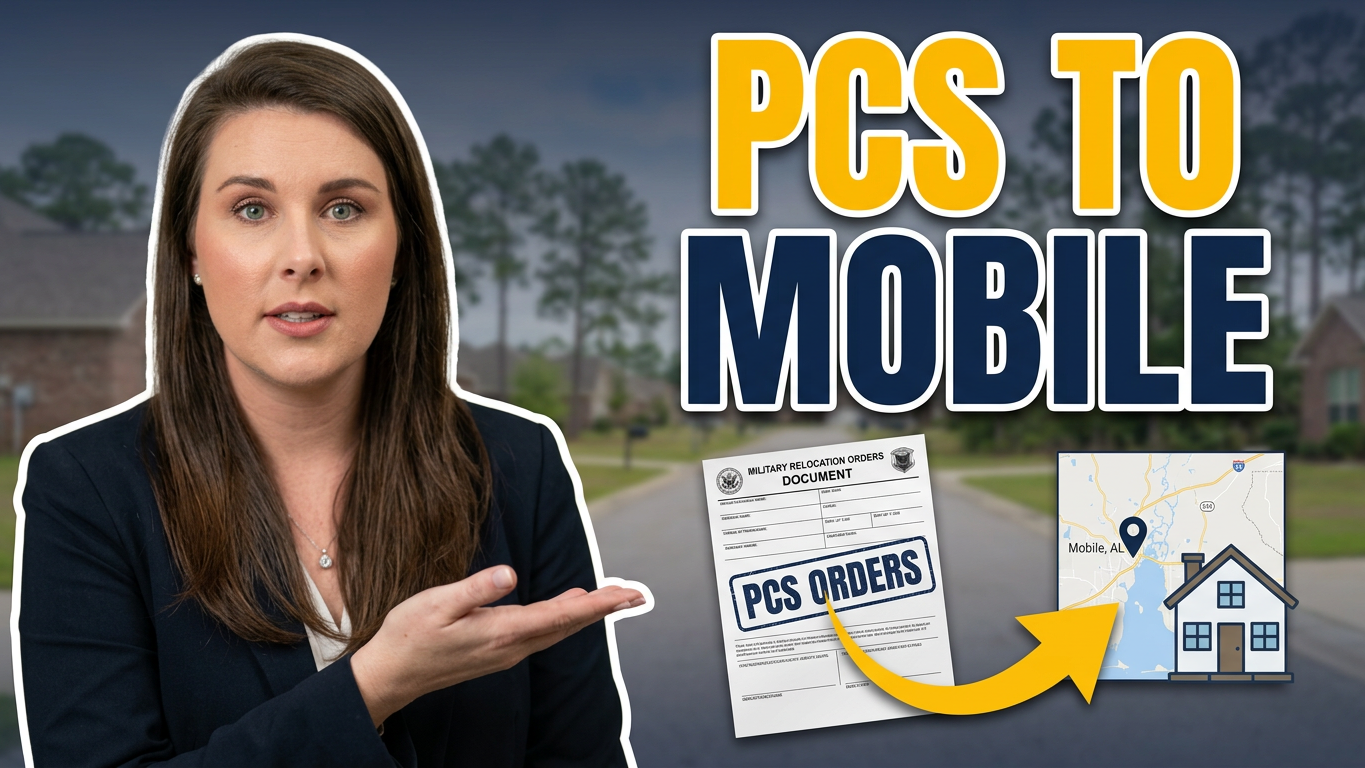
Orders to Mobile can sound deceptively simple until you actually start trying to figure out where you should live.
If you're reporting to Aviation Training Center Mobile, your housing search may look completely different from someone assigned to Sector Mobile. If you're considering Saraland in North Mobile County, Spanish Fort or Daphne because you like the Eastern Shore, or West Mobile because you want to stay closer to ATC, your commute, insurance costs, home prices, daily routine and long-term resale strategy can all change dramatically. Add VA financing, Gulf Coast insurance, flood considerations, new construction incentives and the very real possibility that the military moves you again in a few years, and "just find a house somewhere around Mobile" stops being much of a plan.
That's exactly why I wouldn't start your PCS search on Zillow.
I spent more than a decade building my real estate career around Camp Lejeune in Eastern North Carolina. I was a Marine Corps spouse, my husband, Mike, is now a retired Marine, and military moves were simply part of our life. Over the years, me and my team helped thousands of active-duty service members and veterans buy and sell homes through PCS orders, deployments, retirements, separations, remote closings and all the weird timing problems that come with military life.
Now our family is back home in South Alabama, and through Camellia Real Estate Group I get to bring that experience into a military market that works very differently from Jacksonville, North Carolina.
Mobile isn't built around one giant installation. The military presence here is spread across several commands and locations, and that makes geography far more important than it may look when you first pull up a map.
The largest active-duty military presence here is the Coast Guard. Aviation Training Center Mobile, on Tanner Williams Road in West Mobile, is a major Coast Guard aviation training and operational center. It trains pilots, rescue swimmers and aircrews from around the country while also supporting search and rescue and other aviation missions. Coast Guard Sector Mobile operates closer to the central and southern part of the city and supports maritime law enforcement, search and rescue, port security, environmental protection and other operations along the Gulf Coast. Mobile is also home to the Coast Guard Gulf Strike Team, and the city has Marine Forces Reserve units, including 3rd Force Reconnaissance Company, 4th Marine Division.
That means two service members can both tell me they're "moving to Mobile" and need completely different housing plans.
If you're headed to ATC, living in West Mobile may give you a far easier daily routine than choosing a house on the opposite side of the metro simply because someone online said that neighborhood was more desirable. If you're working closer to downtown or Sector Mobile, another location may make more sense. If you're drawn to Spanish Fort or Daphne, the Eastern Shore may be a great fit, but you need to understand that your commute involves crossing Mobile Bay. Plenty of people do it every day, but it should be a conscious decision, not something you discover after you buy.
The same is true of Saraland.
I grew up in Saraland, moved back here and am building Camellia here, so I'm obviously very comfortable talking about North Mobile County. If you're considering Saraland because of the newer housing options, the community feel or simply because you like what the city offers, that can absolutely be part of the conversation. What I'm not going to do is tell every military buyer that Saraland is automatically the right answer just because I happen to love it. If your duty location, work schedule, commute tolerance or other needs point somewhere else, then we need to look somewhere else.
The point of a military relocation consultation shouldn't be to steer you toward the agent's favorite area. It should be to help you understand how the different parts of Mobile and Baldwin County fit your actual life.
I Want to Know How You Live Before I Start Showing You Houses
One thing I learned very quickly around Camp Lejeune is that military buyers aren't interchangeable.
A young Coast Guard member buying a first house has different priorities from a retiring Marine who plans to stay in South Alabama permanently. Someone who cares most about the commute will weigh things differently from someone who cares most about land, a particular school system or a certain lifestyle. Someone expecting another PCS in three years should evaluate a purchase differently from someone who has already retired and wants to buy the house they plan to own for the next twenty.
So before we ever start narrowing neighborhoods, I want to understand what you're actually trying to build here:
- How long do you realistically expect to stay?
- Is this another duty station, or are you hoping South Alabama becomes home?
- How important is the commute?
- Are specific school systems a factor in where you're willing to live?
- Do you want new construction, an established neighborhood, acreage, a pool, a workshop or a smaller low-maintenance house?
- Do you want to be close to downtown, close to work, close to the bay or close to absolutely nothing?
All of those answers change the search.
That's why I'm much less interested in handing you a generic list of "best neighborhoods for military buyers" than in helping you understand what each area gives you and what it asks you to trade in return.
If Schools Are a Priority for You, Say So Up Front
Buyers moving into the area often ask about Saraland specifically because of its school system. If schools are one of your priorities, that belongs at the beginning of the conversation.
What I want to avoid is reducing the decision to one factor.
A school system may matter a great deal to you, but it still has to work alongside your commute, housing budget, insurance costs, daily schedule and how long you expect to own the house. And because attendance zones and school information can change, I'll always point you to the school system itself to verify which schools serve a specific address.
If you're reporting to ATC and you love Saraland, we should look at that commute honestly. If you're working closer to downtown and the drive is easier, that changes things. If two people in the household are commuting in completely different directions, that matters too.
Military life already dictates enough of your schedule. I don't want your housing choice adding unnecessary stress simply because somebody told you there was one "right" city to pick.
VA Financing Should Be Part of the Strategy, Not an Afterthought
If you're eligible for a VA loan, it's one of the first financing options I want on the table.
I'm very pro-VA because I've watched the benefit work exceptionally well for service members and veterans over and over again. For many eligible buyers, especially veterans receiving qualifying service-connected disability compensation, VA financing can be extremely hard to beat. No required down payment, no monthly private mortgage insurance, potentially favorable interest rates and a possible funding fee exemption can add up to a very strong financing package.
Where I get much more cautious is lender selection.
I don't care how military-friendly the advertising looks.
I don't care whether the company logo has a flag in it.
I don't care how many times the website says "we serve those who served."
I want to know what the loan actually costs you.
That means comparing rates, APR, points, lender-controlled fees, lender credits, cash to close and the quality of the person handling the file. I also want to know whether the loan officer actually understands VA financing well enough to handle entitlement, residual income, disability compensation, PCS timelines, lender overlays and any complications that come up.
One of the most important lessons from years in a military market is that there's a huge difference between a lender that offers VA loans and a lender that really knows VA lending.
If you're buying new construction, I also want the builder's lender included in that comparison. Sometimes builder incentives are so aggressive that the affiliated lender really does offer the best overall deal. If that's the case, use it. I'm not interested in steering you away from a good loan just because it comes from the builder.
I just want the numbers to win, not the sales pitch.
South Alabama Insurance Can Change What "Affordable" Looks Like
This is one of the biggest things I'd want a military buyer moving from another state to understand before shopping seriously.
Two homes with the same purchase price can have very different monthly ownership costs here, because homeowners insurance is a major part of the equation.
South Alabama is a coastal insurance market, even when the property itself is nowhere near the beach. Wind exposure matters. Hurricane deductibles matter. Roof age matters. Construction quality matters. FORTIFIED construction can matter. Flood insurance is a separate issue entirely.
If we're comparing a newer Gold FORTIFIED home with an older resale home, I don't want to guess which one is cheaper to own. I want actual insurance quotes on the addresses.
The older house may still be the far better value because it has a bigger yard, mature trees, a fence, a pool and improvements you'd otherwise have to pay for yourself. On the other hand, the newer FORTIFIED home may have enough of an insurance advantage that the monthly difference between the two is much smaller than the purchase prices suggest.
Roof age deserves its own attention, because insurance carriers may look at the roof very differently than you or I do. A roof can still be working fine and still create underwriting limits or materially different pricing with certain carriers.
That's why insurance belongs early in the home-buying process.
I don't want you learning three days before closing that the monthly payment you thought you were getting was never realistic for the house you chose.
Flood Insurance Requires a Property-Specific Conversation
You're going to hear people say things like, "That house isn't in a flood zone."
What they usually mean is that it isn't in one of the higher-risk FEMA flood zones where the lender requires flood insurance.
Those aren't the same thing.
Flood risk varies property by property, and standard homeowners insurance doesn't cover flooding. A house can be outside a lender-required flood zone and still flood under the wrong conditions.
That doesn't mean every buyer in South Alabama needs to panic and buy every type of insurance available. It means we need to look at the particular house, the flood mapping, the surrounding drainage, the history when it's available, and the cost of optional coverage.
I'm not going to tell you "Saraland doesn't flood," "West Mobile is safe," or "you don't need flood insurance because your lender didn't require it."
Water doesn't care what city is on your mailing address.
We evaluate the property.
New Construction Can Make a Lot of Sense During a PCS
New construction can be especially appealing when you're moving from several states away, because there are fewer unknowns than with an older property.
The roof is new. The HVAC is new. The electrical and plumbing systems are new. The builder may provide a warranty. Some South Alabama communities offer FORTIFIED construction. Builders may also offer substantial closing cost help or mortgage rate incentives.
When you're already coordinating orders, household goods, work schedules, pets, vehicles, temporary lodging and everything else that comes with a PCS, there's real value in not immediately inheriting a list of deferred maintenance projects.
That doesn't mean new construction is always the better purchase.
The lot may be smaller. The yard may not be fenced. Mature landscaping may not exist. You may have to buy blinds, appliances, irrigation, landscaping or other things that already come with an established resale home. The builder's incentives may also make the financing look better than the home itself actually is.
This is why I want the buyer represented.
The builder's sales rep represents the builder.
That doesn't make the rep the enemy. I've worked with excellent builder sales teams and superintendents, and good ones can be incredibly helpful.
Their job is simply different from mine.
I want to compare the builder's financing, understand the contract, verify what's actually included in the home, evaluate the lot, talk through inspections, and compare that new house against what else you can buy in the market.
And yes, I still recommend independent inspections on new construction.
New doesn't mean perfect.
If the Military May Move You Again, Let's Talk About Your Exit Before You Buy
This is one of the habits I carried with me from Camp Lejeune.
When an active-duty buyer purchases a house, I'm thinking about the future sale before we even close.
That doesn't mean I want you buying a boring house just because it may be easier to sell later. You still have to live there.
What it means is that we should be honest about how military timelines affect ownership:
- If you expect to be here for three years and get orders after two and a half, what does the exit look like?
- Would the house appeal to another buyer?
- Will you be competing with a lot of new construction when you sell?
- Are you paying a premium for improvements you're unlikely to recover in a short ownership period?
- Could the house work as a rental if selling at that moment doesn't make financial sense?
- And if it could work as a rental, do you actually want to be a landlord from another state?
That last question is especially important.
Military homeowners are often encouraged to keep every house they ever buy and slowly build a rental portfolio. Sometimes that's a fantastic strategy.
Sometimes it leaves you managing a mediocre rental 900 miles away while trying to solve maintenance problems from your next duty station.
Keeping a property should be a financial decision, not a military rite of passage.
Buying Remotely Is Possible, but the Video Tour Needs to Show You What the Pictures Don't
I've helped plenty of military buyers purchase houses without seeing them in person first.
It can absolutely work.
The key is understanding what a remote buyer actually needs from the agent.
You don't need me to FaceTime you from the kitchen and tell you there are granite countertops. The listing photos already told you that.
I want to show you what the listing doesn't:
- How close are the neighboring houses?
- What does the street look like as I drive in?
- Can I hear traffic from the backyard?
- Does the yard slope toward the house?
- Is there standing water somewhere that didn't make the professional photos?
- Does the house smell damp?
- Does the neighborhood feel different three streets away from the listing?
- Does the primary bedroom actually feel large, or is the wide-angle lens doing heroic work?
- What's behind the property?
- What does the commute feel like when we actually drive the route?
- If I were standing in the house with you, what would I point out before you made a decision?
That's what I want to communicate.
My job isn't to make the house look good on video.
My job is to make sure you understand the house well enough to make your own decision from wherever the military currently has you.
Buying Before You Arrive Means Planning the Logistics, Not Just the Contract
PCS timing is rarely as clean as everyone wants it to be.
Your report date may not line up with the closing date. Your lease at your current duty station may end first. One spouse may move ahead of the rest of the household. Household goods may arrive later. Orders can change. Leave dates move. Somebody inevitably discovers that the closing appointment conflicts with something the military considers far more important than your mortgage.
We need to build the transaction around the reality of your move.
That may mean temporary lodging. It may mean one spouse signing before the other. It may involve electronic signatures or a properly prepared power of attorney when appropriate. It may mean intentionally leaving some time between closing and the date you absolutely have to be in the house.
I don't like transactions where everything has to happen perfectly on one specific day or you have nowhere to sleep.
Military life already gives us enough uncertainty.
When we can build in breathing room, I want it.
Buying vs. Renting Deserves an Honest Conversation
I spent years selling houses to military buyers, so I'm certainly not going to tell you buying is a mistake just because you may PCS again.
But I'm also not going to tell every military buyer that buying is automatically smarter than renting.
A lot of things matter here:
- How long you expect to stay
- Transaction costs
- Your VA financing
- The condition of the house
- How much cash you have
- The rental market
- Your tolerance for becoming a landlord later
- The particular property
If you're likely to be here only a short time, have very little cash left after closing, and are considering a house that will need expensive work, buying just because VA lets you put zero down may not be the best move.
On the other hand, if your payment compares favorably with rent, the house is a strong fit, you have enough reserves, and the property is likely to stay marketable when the next PCS comes, buying may make excellent sense even if you aren't staying forever.
The answer isn't "military buyers should buy."
The answer isn't "military buyers should rent."
The answer is whether you should buy this house under these circumstances.
If You're Retiring Here, Tell Me That Immediately
A retirement move changes almost everything about the conversation.
If Mobile or South Alabama is where you're finally planning to stop moving, I care far less about how easily we could sell the house in three years and much more about whether you'll still enjoy living there fifteen years from now.
Maybe this is when you finally buy the acreage.
Maybe this is when you build the workshop.
Maybe you want the pool.
Maybe you care more about boat storage than being close to the interstate.
Maybe you're willing to renovate because you're no longer wondering whether orders will come before you finish the kitchen.
Your financing may look different too, especially if you're retiring with a compensable service-connected disability and are exempt from the VA funding fee.
That's why I want to know whether Mobile is another assignment or the place where the PCS cycle finally ends.
Those aren't the same home purchase.
What I'd Do First if I Were PCSing to Mobile
I wouldn't start by saving houses.
I'd start by understanding the assignment:
- Where exactly are you working?
- When do you report?
- What does the daily schedule look like?
- What do you need the house to do for you?
- What monthly payment actually feels comfortable?
- Have you used your VA benefit before?
- Do you still own another home?
- Are you receiving VA disability compensation?
- Do you expect this to be a three-year purchase or a long-term home?
Once I know those things, I can start helping you narrow the map.
Maybe the answer is West Mobile.
Maybe it's Saraland.
Maybe it's Satsuma.
Maybe Spanish Fort or Daphne makes sense despite the bay commute.
Maybe another part of Mobile fits your life better than any of those.
The goal isn't to prove that one place is "best."
The goal is to find the place that makes the most sense for the way you're actually going to live.
Mobile Is a Different Military Market, and That's Part of What Makes It Appealing
For years, I worked in a community where the military touched almost every part of the housing market.
Mobile isn't that.
There's a meaningful military presence here, especially through the Coast Guard, but the local economy and housing market are much broader than the military community alone. You can live somewhere that feels urban, suburban, historic, coastal, rural or somewhere in between without moving very far.
That gives military buyers more choices.
It also means there isn't one obvious place everyone assigned here should live.
I think that's a good thing.
You simply need someone helping you understand what each choice actually means.
I spent more than a decade learning what military buyers need from an agent, because they were my clients, my neighbors and my own community. I know why the spouse may be handling most of the move while the service member is somewhere else. I know why a remote buyer needs more than a pretty FaceTime tour. I know why another set of orders should stay somewhere in the back of our minds, even while we're buying the house in front of us.
That experience is a major part of what me and my team want Camellia Real Estate Group to bring to service members and veterans in South Alabama.
We aren't going to call ourselves military-friendly because we put a flag on a postcard.
I spent too many years in the trenches for that.
If you're trusting us with a PCS to Mobile, I want us to understand the duty station, the commute, your VA benefit, South Alabama insurance, the house you're buying now, and the house you may eventually need to sell or rent when the military changes the plan again.
That's the job.
And if your orders say Mobile, I'd rather have that conversation with you before you choose the neighborhood, before you commit to a lender, and definitely before you fall in love with a house on Zillow.
Orders say Mobile? Let's talk first.
Talk With Our Team About Your PCS to MobileCheck out this article next