Buyer Guide
Appraisal vs. Home Inspection
They aren't the same thing, and buyers need both.
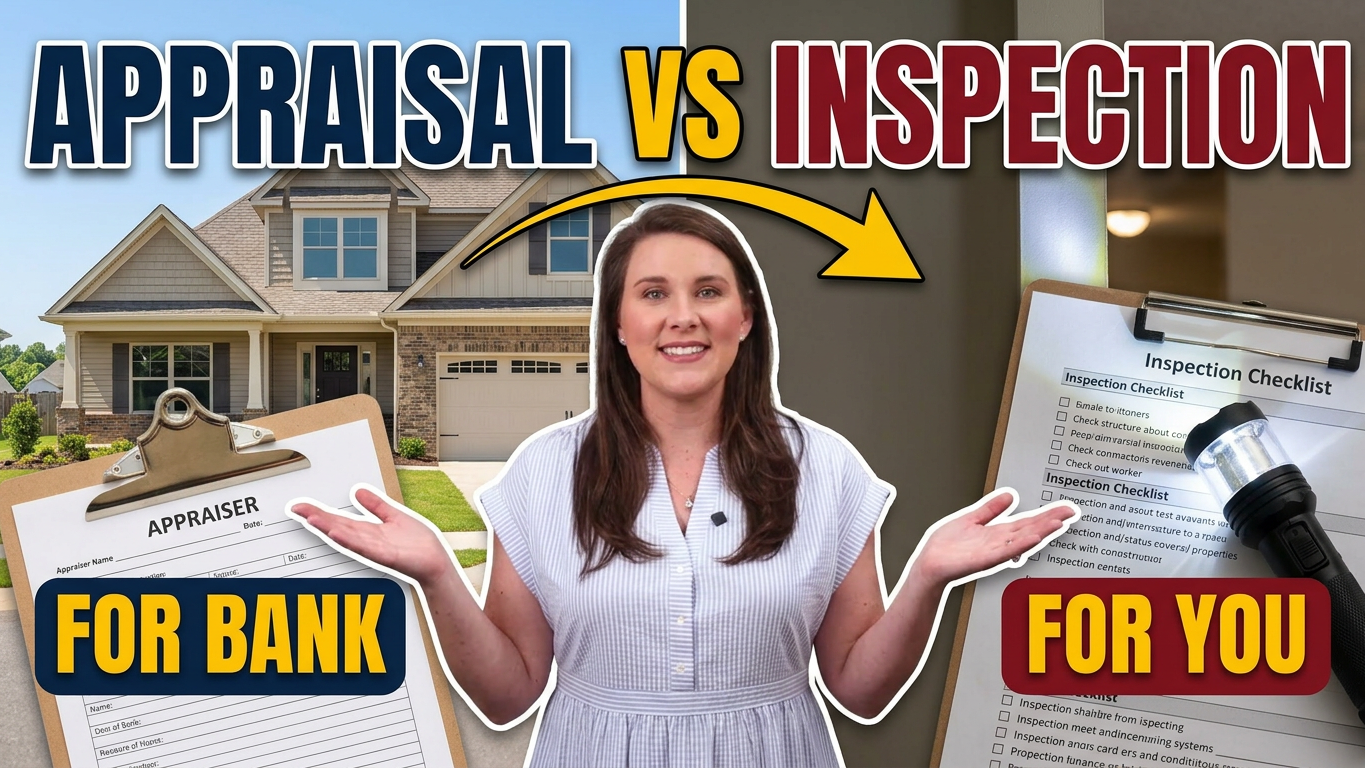
Buyers often hear the words appraisal and inspection in the same week, pay for both, get two different reports, and understandably assume they're doing basically the same job.
They aren't.
The appraisal answers a question for the loan:
Does this property support the financing?
The inspection answers a question for you:
What am I actually buying?
Those are two very different questions, and they can produce very different information about the exact same house.
A property can appraise at full value and still have an aging HVAC system, moisture in the crawlspace, electrical concerns, plumbing issues or a roof that may need attention sooner than you expected.
A home inspection can identify twenty items and still have absolutely no effect on the appraised value or the lender's willingness to finance the property.
And with VA financing, the appraisal has an extra role, because the appraiser also looks for readily apparent conditions that may keep the property from meeting VA Minimum Property Requirements. That still doesn't turn the VA appraisal into a home inspection.
Understanding that difference is one of the most important things a buyer can do before either report arrives.
The Appraisal Is About the Loan and the Value of the Property
If you're financing a home, your lender needs to know the property is worth enough to support the amount being borrowed.
That's the basic purpose of the appraisal.
The appraiser looks at the property, analyzes comparable sales and other market information, and develops an opinion of market value. If you're buying a home for $400,000, the lender wants reasonable support that the property is actually worth around that amount before lending against it.
That matters because the house is collateral for the mortgage.
If the appraisal supports the purchase price, that part of the financing can move forward.
If the appraisal comes in low, we have a value problem to solve.
The important thing to understand is that the appraisal isn't mainly there to tell you whether the house is in great condition.
It's there to establish value for the loan.
A VA Appraisal Has One Additional Job
With VA financing, the appraisal also includes a review for VA Minimum Property Requirements.
That means the VA appraiser isn't only developing an opinion of value, but also looking for readily apparent conditions that may affect whether the property meets VA's basic standards for safety, structural soundness and sanitation.
So if there's an obvious condition, like significant wood rot, a serious safety issue, major water intrusion or another problem that appears to violate VA requirements, the appraiser may call for a repair or further review.
But this is where buyers get confused.
The fact that a VA appraiser looks at some property condition issues doesn't mean the appraiser is performing a full home inspection.
They aren't opening every panel, testing every component, crawling through every accessible space or trying to identify every defect that may matter to you as the future owner.
The appraisal is still an appraisal.
Its main purpose is tied to the loan.
The Inspection Is About the House You're Going to Own
The inspection has a different purpose entirely.
A home inspector looks at the condition of the property in much greater detail so you can understand what you're buying.
Depending on the property and the inspector's scope, that can include the roof, attic, crawlspace, foundation, electrical system, plumbing, HVAC, windows, doors, appliances, drainage, visible structural components, moisture conditions and other systems.
The inspector isn't trying to decide whether the house is worth $400,000.
They're trying to tell you what appears to be working properly, what isn't, what may need repair, what may need a closer look and what you should understand before you become responsible for the property.
That's why I care so much about the inspection.
Once we close, the lender doesn't own the HVAC system.
You do.
The lender doesn't pay for a leaking water heater, a damaged electrical panel or moisture remediation under the house.
You do.
The inspection gives you information about those things before ownership transfers.
A House Can Appraise Beautifully and Still Have Expensive Problems
This is where the difference gets very real.
Imagine the appraisal comes back at full value. Great.
That tells us the appraiser found enough market support for the purchase price and, with VA financing, didn't identify unresolved conditions that kept the property from meeting the appraisal requirements.
It doesn't tell us whether the HVAC system is twenty years old.
It doesn't tell us whether the water heater is nearing the end of its life.
It doesn't necessarily tell us whether there's a slow plumbing leak under a sink, not enough insulation in the attic, a drainage problem in the backyard or moisture starting to build in the crawlspace.
Those are exactly the kinds of things the inspection is designed to help us understand.
That's why I never want a buyer saying, "Well, the appraisal was fine, so I guess the house is fine."
Those aren't the same conclusion.
The Inspection Can Find Problems Without Meaning You Should Walk Away
The reverse is also important.
Home inspection reports can look intimidating.
A good inspector documents what they observe, and even a well-maintained house can produce a long report, because houses have a lot of components.
A twenty-page inspection report doesn't mean you bought a disaster.
We have to look at what's actually in it.
There's a big difference between a loose toilet handle and evidence of active structural movement.
There's a big difference between a GFCI outlet that needs correcting and widespread unsafe electrical work.
There's a big difference between an older HVAC system that's working normally and one that's actively failing.
This is where the inspection becomes part of the decision-making process instead of a simple pass-or-fail test.
The inspector gives us information.
Then we decide what that information means.
The Inspection Happens While You Still Have Decisions to Make
This is another reason timing matters.
In a typical purchase, the inspection takes place during the period when the buyer still has contractual rights to investigate the property and make decisions based on what's found.
That may mean accepting the property as-is.
It may mean asking the seller to repair something.
It may mean bringing in another professional to evaluate a specific issue.
It may mean changing the terms of the transaction, if the contract allows it.
And occasionally, it may mean deciding the problem is significant enough that the buyer no longer wants the house.
That's exactly why I want the inspection done early enough to be useful.
I don't want you learning about a serious problem after you've already committed yourself emotionally and financially to closing.
What Happens When the Appraisal Comes In Low?
A low appraisal creates a financing problem, not an inspection problem.
If the buyer and seller agree on a price but the appraisal supports a lower value, the lender may not be willing to lend based on the higher contract price.
At that point, the possible solutions depend on the loan, the contract, the parties and the facts behind the valuation:
- Sometimes the price is renegotiated.
- Sometimes there's legitimate evidence to support a reconsideration of value.
- Sometimes the buyer chooses to bring more money to the transaction.
- Sometimes the parties can't reach an agreement and the transaction doesn't move forward.
The important distinction is that we're solving a value issue.
What Happens When the Inspection Finds a Problem?
That's a condition issue.
The inspector may find a roof problem, electrical concern, plumbing issue, moisture condition, structural concern or something else that deserves attention.
Then we figure out how serious it is, whether we need another professional involved, what the contract allows us to do and whether the buyer is still comfortable moving forward.
The seller may agree to repair it.
The buyer may accept it.
The parties may negotiate another solution.
Or the issue may change the buyer's decision entirely.
Again, that's a completely different purpose from the appraisal.
What Happens When the VA Appraiser Finds a Repair Issue?
This is the one area where appraisal and condition overlap.
If a VA appraiser sees a readily apparent condition that doesn't meet VA Minimum Property Requirements, the property may need to be repaired or otherwise addressed before the loan can close.
That might sound similar to something a home inspector would find, because sometimes both professionals notice the same obvious problem.
The difference is what happens next.
The inspector is giving you information so you can make a decision about the property.
The VA appraiser is identifying a condition that may affect whether the property is acceptable for VA financing.
Those are still two different roles.
"It Passed VA" Doesn't Mean VA Inspected the House for You
This is probably the biggest misconception I want to clear up.
If someone says, "The house passed VA," don't take that to mean the federal government inspected the house and guaranteed everything is in good condition.
That isn't what happened.
The appraisal supported the financing, and the property met the applicable VA appraisal requirements.
That's useful.
It isn't a warranty.
It doesn't guarantee nothing will break after closing.
It doesn't guarantee the roof has ten years left.
It doesn't guarantee the HVAC will survive an Alabama August.
It doesn't guarantee the plumbing, electrical, drainage, crawlspace, pool, appliances or other systems are free from defects.
That's exactly why the independent inspection matters.
I Want Both Pieces of Information Before You Make a Decision This Expensive
When I'm representing a buyer, I don't want to get so focused on making the loan work that we forget you're actually buying a house.
The financing matters.
The value matters.
The condition matters.
And they aren't all answered by the same person.
Sometimes both reports come back with very little drama.
Sometimes the inspection uncovers something significant while the appraisal is perfectly fine.
Sometimes the appraisal creates a value issue even though the inspection is excellent.
Sometimes a VA appraisal identifies a condition that has to be corrected before closing, while the inspection gives us a much broader picture of everything else going on in the house.
That's why I don't think of one as replacing the other.
After more than a decade helping buyers purchase homes, I've seen people put far too much confidence in the phrases "it appraised" and "it passed VA."
Neither one tells me enough.
I don't want you buying a house because it passed the appraisal.
I want you buying it because you understand the value, understand the condition, understand the risks, and still want the house.
The appraisal helps us understand the value and the financing.
The inspection helps us understand the house.
You need both before you make a decision this expensive.
If you're buying in South Alabama, me and my team are happy to walk you through both reports when they come in.
Want help reading both reports?
Talk With Our Team About Buying a HomeCheck out this article next