Military Buyer Guide
How to Choose a VA Lender
What actually matters most: VA knowledge, service, the real cost of the loan and making lenders compete.
If you're using a VA loan to buy a home, the most important thing about your lender isn't the logo, the commercial or even the first rate they quote you.
It's whether they actually know VA.
I spent more than a decade working with military buyers and sellers around Camp Lejeune, and there's a very real difference between a loan officer who truly understands VA financing and one who simply has access to the product. That difference often doesn't show up on the first phone call, when everything is easy and the lender is trying to earn your business. It tends to show up later, once you're under contract and something requires real knowledge of entitlement, residual income, funding fee exemptions, appraisal issues, seller concessions, lender overlays, or the fact that you already own another VA-financed property.
That's when experience matters.
A veteran has earned an extraordinarily valuable benefit. I don't want the person handling that benefit learning how it works while we're trying to get your house closed.
VA Knowledge Comes First
Before I care what rate a lender is quoting, I want to know whether the person handling the loan understands VA well enough to deal with the situations that routinely come up:
- If you've used your VA benefit before, can they explain what your Certificate of Eligibility shows and whether you have full or remaining entitlement?
- If you still own another VA-financed home, can they calculate what that means for the next purchase?
- If you receive service-connected disability compensation, have they correctly identified whether you're exempt from the VA funding fee?
- Do they understand that VA itself doesn't set a universal minimum credit score, even though their company may have its own overlay?
- If the appraisal comes in low, do they understand the Reconsideration of Value process well enough to help move it correctly?
- If the seller is contributing money, do they understand the difference between ordinary closing costs and VA's separate seller concession rules?
Those aren't exotic edge cases. They're normal VA questions.
A loan officer doesn't have to recite the VA handbook from memory, but I want someone who understands the product well enough to recognize the issue, know where the rule comes from and explain the answer accurately. What I don't want is a veteran being told "VA doesn't allow that" when the real answer is that the lender doesn't allow it, or being told something is fine only to find out in underwriting that nobody checked the actual VA rule.
That's why military branding means very little to me by itself. Some national companies market heavily to service members and veterans and also have excellent VA loan officers. Others have built a tremendous military-facing brand but may still assign you an originator whose VA knowledge is average. On the other side, a local or regional lender with very little military advertising may have a loan officer who has spent decades closing complicated VA loans.
I care far more about the person handling the file than whether the company name sounds military.
VA itself tells veterans to compare lenders, because the mortgage generally comes from a private lender, not directly from VA, and those lenders can offer different rates and fees.
Service Comes Next, Because Knowledge Isn't Enough if Nobody Communicates
Once I'm confident the lender understands VA, service moves straight to the top of the list.
A home loan doesn't happen separately from the rest of the purchase. The mortgage has to move alongside inspections, the appraisal, insurance, title work, underwriting, contract deadlines and closing. A knowledgeable loan officer who doesn't communicate can still make a transaction unnecessarily hard.
I want someone who returns calls, responds when there's a problem and tells us what's needed before it becomes an emergency. I want the buyer to know where the loan stands instead of spending three days wondering whether anyone looked at the document they uploaded. I want a lender who knows the closing date in the contract and works backward from it, instead of discovering at the end that underwriting still needs something important.
That matters even more with VA, because there are already plenty of misconceptions around the loan. If the lender can't clearly explain what's happening, uncertainty spreads fast. The buyer gets nervous, the seller hears there's a "VA issue," the listing agent starts worrying the loan is in trouble, and suddenly a perfectly manageable situation turns into unnecessary drama.
A strong VA lender does the opposite. They know what the problem is, explain it clearly, tell everyone the next step and keep the transaction moving.
That level of service matters to me almost as much as the knowledge itself.
The CFPB makes the same broader point when it tells buyers that choosing a lender should include not only the cost of the loan, but also confidence in the loan officer's ability to answer questions and meet the closing timeline.
Then We Look at What the Loan Actually Costs
Once I know the lender understands VA and can take care of the buyer, I get very serious about the money.
This is where veterans need to stop comparing lenders based on one headline rate.
A lender can quote an attractive interest rate and still have a more expensive loan once you account for points, origination charges, lender credits and other lender-controlled fees. Another lender may quote a slightly higher rate but charge much less upfront. Both can be legitimate offers, but you can't tell which one is better by looking only at the rate.
That's why I want actual Loan Estimates whenever possible.
The CFPB specifically recommends comparing the loan amount, interest rate, monthly payment, upfront loan costs, origination charges, lender credits and cash to close, and it encourages buyers to pay special attention to the costs the lender actually controls.
That's where the comparison gets useful.
Look Closely at the Origination Fee and the Rest of the Lender-Controlled Charges
VA has its own rules about what veterans may be charged. VA says lenders may charge a flat fee of up to 1% of the loan amount, often called the loan origination fee, and veterans may also pay certain reasonable and customary charges. VA's fee rules are designed so lenders can't simply stack unlimited origination-related charges onto a VA borrower outside that structure.
That 1% number is important, but I don't want buyers to stop there.
A lender may charge less than 1%. Another may structure its allowable charges differently. The Loan Estimate may show origination charges, points, lender credits and other costs in ways that make one offer look cheaper until you actually compare the full page.
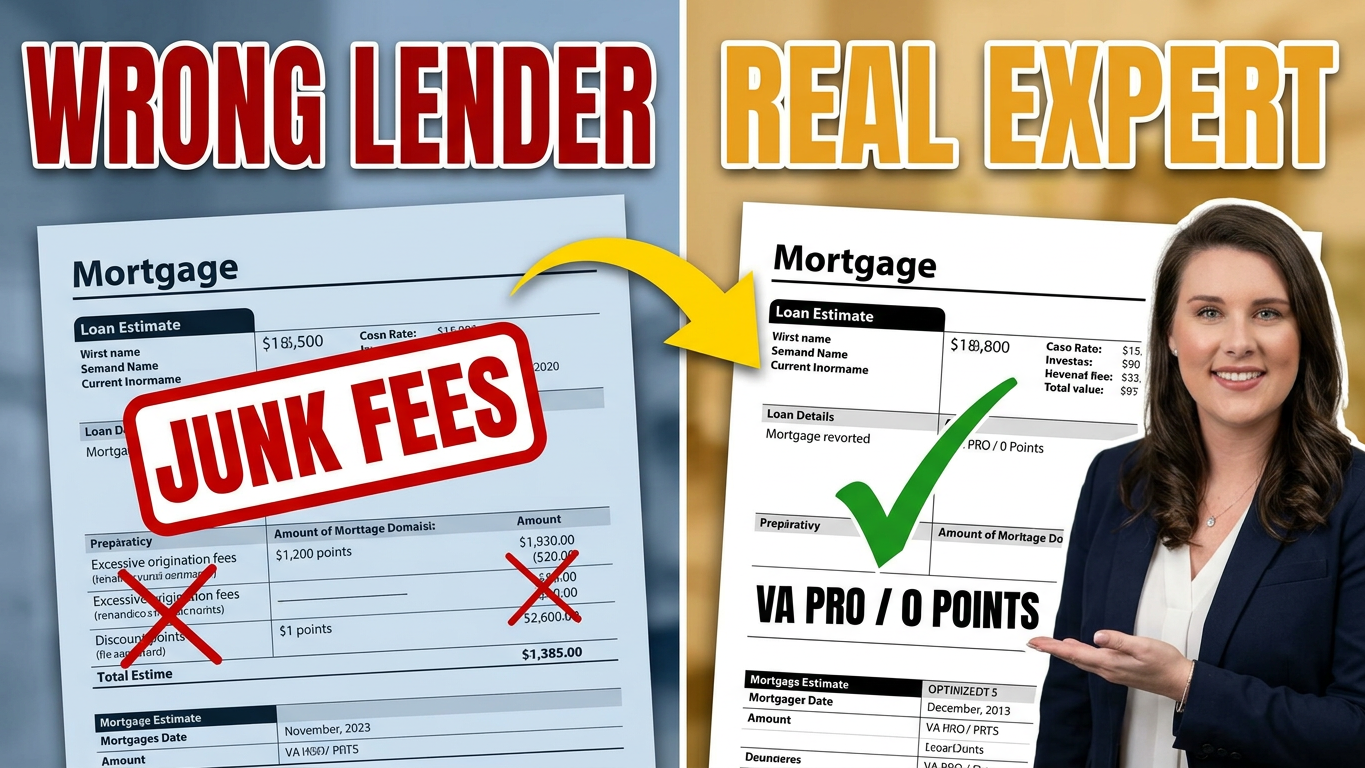
This is where the fees buyers often call junk fees deserve attention.
I use that phrase carefully, because not every fee with an unfamiliar name is illegitimate. Lenders have real expenses and are allowed to make money. I'm not looking for a mortgage company to work for free.
What I care about are vague, duplicate or unusually high lender-controlled charges that make an attractive-looking loan much more expensive than the buyer realizes.
Processing fees. Administrative fees. Underwriting fees. Document fees. Application charges. Whatever the label on the estimate, I want to know whether the fee is allowed, who's charging it, what it's for and whether another lender is charging the same thing.
VA's rules specifically separate the flat origination charge from the reasonable and customary fees a veteran may pay, and certain origination-related costs are supposed to be covered within that flat fee instead of itemized on top of it.
So if one lender's estimate has a lot more lender-controlled charges than another's, I want an explanation.
I'm not automatically offended by an origination fee. Sometimes the lender charging one still has the best rate, the best service and the best overall loan.
What I don't want is a veteran sold on a low rate while several thousand dollars of extra lender charges sit quietly two pages deeper in the Loan Estimate.
That's why we compare the whole thing.
Points Can Make a Cheap-Looking Rate Very Expensive Upfront
Discount points deserve the same scrutiny.
Points are money paid to the lender upfront in exchange for a lower interest rate. The CFPB describes them as an upfront fee paid to get a lower rate than the borrower would otherwise receive.
There's nothing wrong with paying points when the math supports it.
If a veteran plans to stay in the house for a long time, paying more upfront for a lower payment may be a good decision.
For an active-duty buyer who may get PCS orders in two or three years, I'm much more interested in how long it takes to recover that upfront cost.
If you spend $6,000 today to reduce the payment by $125 a month, you need to stay in that loan for four years before the savings catch up with what you paid.
If you sell or refinance before then, you may never recover the cost.
So when a lender says, "I have the lowest rate," my next question is always, "What does that rate cost?"
That's a much better comparison.
Make the Lenders Compete for Your Business
Veterans should shop their mortgage.
There's nothing disloyal or difficult about that. This is a major financial transaction, and lenders know borrowers compare offers.
The CFPB specifically recommends getting multiple Loan Estimates, because competing offers give you a better basis for comparison and negotiation:
- If one lender has lower fees, show the other lender.
- If one lender has a better rate with the same points, ask whether your preferred lender can match it.
- If one offers a lender credit, ask what happens to the rate in exchange for that credit.
- If one lender has much higher origination charges, ask them to explain why.
The answer may be perfectly reasonable.
Or they may improve the offer.
Either way, I want the buyer making the decision with real information.
What I wouldn't do is chase the absolute cheapest estimate at the expense of competence and service. If two lenders are a few hundred dollars apart but one clearly understands VA better, communicates better and has a much stronger record of closing on time, that difference may be worth paying.
The goal isn't simply to find the cheapest lender.
It's to find the best combination of VA competence, service and price.
One Lender Saying No Doesn't Always Mean VA Said No
This is one of the reasons VA knowledge ranks above price for me.
Individual lenders can set underwriting standards that are stricter than VA's own requirements. Those extra standards are commonly called overlays.
Credit scores are an easy example. VA doesn't set one universal minimum credit score for every VA-backed purchase loan, but a lender may set its own minimum as part of its underwriting policy.
That means when one lender says no, I want to understand why.
Is the problem actually a VA eligibility requirement?
Is it an underwriting issue that would be a problem anywhere?
Or is it that particular lender's overlay?
Those are very different things.
I'm not suggesting a buyer should shop endlessly for someone willing to approve a loan they can't afford. Real credit, income or underwriting problems still have to be addressed.
But I've seen veterans assume their VA benefit was unavailable when the real answer was simply that the first lender they called wouldn't make that particular loan.
A knowledgeable VA loan officer should be able to tell you which rule you're dealing with.
Funding Fee Knowledge Matters, Too
The VA funding fee can materially affect the cost of the loan, and the lender should know whether you're required to pay it.
VA exempts certain borrowers from the funding fee, including veterans receiving compensation for a service-connected disability and certain other eligible borrowers. For those who aren't exempt, the amount varies based on the type of loan, whether the benefit has been used before and the size of the down payment.
That isn't something I want anyone figuring out three days before closing.
If you're exempt, I want the lender verifying it properly.
If you aren't, I want you to understand what the fee is and how it affects the loan.
Again, this is basic VA competence.
New Construction Deserves the Same Level of Scrutiny
In South Alabama, we're going to work with plenty of VA buyers considering new construction, and builder-affiliated lenders can sometimes offer very aggressive incentives.
I have no problem with that.
If the builder is putting substantial money toward closing costs or buying down the rate, and the affiliated lender is offering the best overall deal, I want my buyer taking advantage of it.
But the size of the incentive doesn't excuse us from comparing the loan.
I still want to see the rate. I still want to see the points. I still want to see the origination charges. I still want to know whether there are other lender-controlled fees. I still want to know how much cash the buyer actually needs and whether the lender understands VA well enough to get the loan closed.
A $10,000 incentive sounds wonderful, but if the lender's pricing is materially worse somewhere else, we need to understand that before deciding what the incentive is really worth.
Sometimes the builder's lender wins easily.
Sometimes it doesn't.
The Loan Estimate tells us.
What I'd Look For if I Were Choosing a VA Lender Myself
If I were using a VA loan tomorrow, I wouldn't start with the rate sheet.
I'd start with the loan officer.
I'd want to know whether they do enough VA business that the program feels routine to them. I'd listen to how they explain entitlement, funding fee exemptions, residual income, appraisal issues and lender overlays. I'd pay attention to whether they answer questions clearly or hide behind mortgage jargon.
Then I'd look at service.
Do they return calls? Do they communicate proactively? Do they have a reputation for meeting deadlines? When something gets complicated, do they solve the problem or disappear until someone else figures it out?
Only after I'm comfortable with those two things would I compare the economics.
Then I'm looking at the Loan Estimates side by side. I want to know the rate, whether points are involved, what the origination charges are, what other lender-controlled fees appear, whether there are credits and how much cash the buyer needs at closing.
I want to know what the loan costs today and what it costs over the time the buyer realistically expects to keep it.
That gives me a much more complete picture than an ad saying "VA rates as low as…"
Why I Want Veterans Talking to Us Before They Commit to a Lender
I don't need to choose your lender for you.
I do want you choosing from a position of knowledge.
After more than a decade working with military families, I've watched excellent VA lenders rescue transactions because they understood the program, communicated well and saw problems coming before they became emergencies. I've also watched perfectly qualified veterans deal with completely unnecessary stress because their loan was handled by someone who didn't understand VA nearly as well as their marketing suggested.
That's why my order is simple.
VA knowledge first. Service second. Then we make sure the loan itself is competitive.
There's nothing wrong with a lender making money on a mortgage.
There's something wrong with a veteran paying more than necessary because nobody bothered to compare the loan carefully.
If you're buying in South Alabama with VA financing, talk with me and my team before you commit to a lender. We can help you ask better questions, read the Loan Estimates more intelligently and make sure the person handling your VA benefit actually knows what they're doing.
Comparing VA lenders?
Talk With Our Team Before You Choose a LenderCheck out this article next